Whereas Ijaw leaders have been battling for total resource control, where states control whatever is generated from their soil and then pay tax to the centre, the sound of the music appears to have changed, with an adjustment of the considerations.
A Niger Delta leader, Elder Joseph Ambakederimo, is now asking for 70 per cent share of funds generated from the region, while the centre would keep the balance.
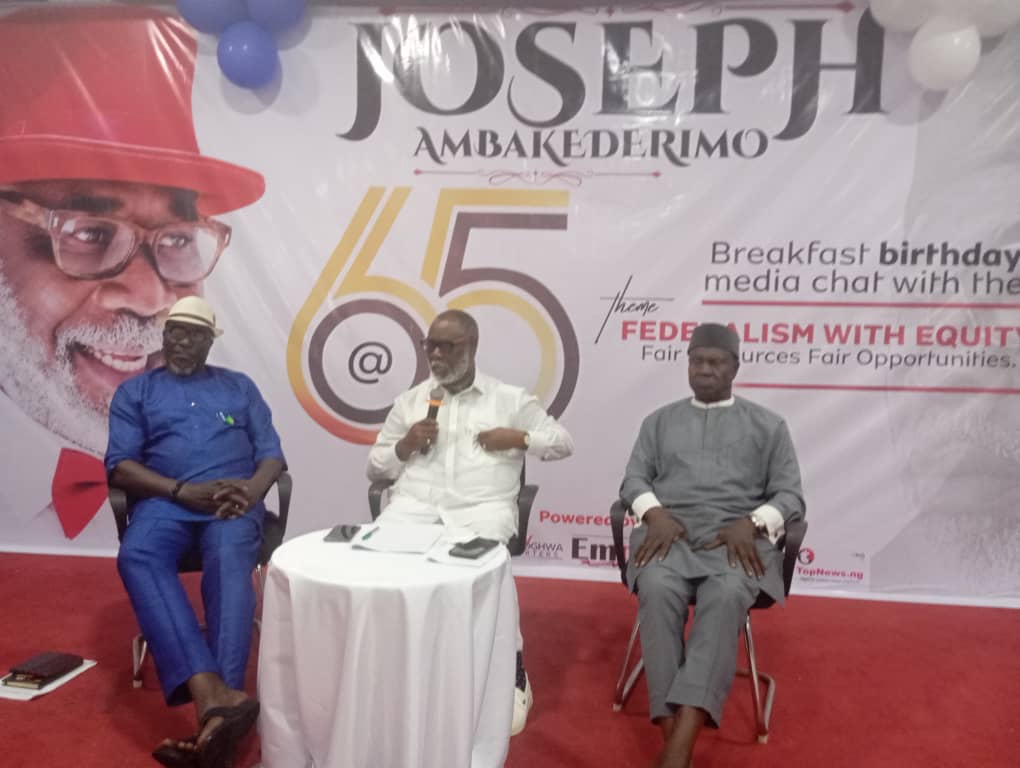
At an event in Yenagoa to mark his 65th birthday, Ambakederimo, who is the convener of the South-South Reawakening Group (SSRG), said Nigeria’s current federal structure was incapable of delivering the rapid development required by the Niger Delta region and the entire country.

He said states should have greater control over their natural resources while contributing an agreed percentage to the Federal Government.
According to him, the arrangement will promote healthy competition among states and enable them to develop according to their resources and priorities.
“The 1963 Constitution provided for 50 per cent derivation, but my recommendation would be 70 per cent retained by the state,” he said.
Ambakederimo said the agitation for resource control remained relevant, particularly because oil-producing communities continued to bear the environmental and economic consequences of resource exploitation.
He noted that the Niger Delta had suffered oil spills, gas flaring, polluted water sources and the destruction of traditional livelihoods despite contributing significantly to Nigeria’s foreign exchange earnings.
He argued that communities bearing the environmental burden should have greater economic benefits from resources extracted from their territories.
The South-South leader said the resource-control debate should not be viewed as an agitation peculiar to the Niger Delta.
He said states that had previously opposed resource control were now discovering valuable mineral resources within their territories and attracting investors.
According to him, this development has demonstrated the potential benefits of allowing states greater control over resources within their domains.
Ambakederimo said Nigeria should return to the principles of the 1963 Constitution, under which regions retained a substantial portion of revenues derived from resources within their territories.
He said the country’s current system had created excessive centralisation and contributed to mutual suspicion among its component parts.
“Let us all contribute to the centre a percentage that will be agreed by all of us and do whatever you deem fit in terms of development you think is sustainable to your people,” he said.
Ambakederimo also advocated comprehensive political restructuring rather than what he described as piecemeal reforms.
He specifically cited local government autonomy and the ongoing debate over state police as examples of reforms that should be considered within a broader restructuring framework.
He called for a holistic review of Nigeria’s policing and governance structures to address insecurity and strengthen development.
According to him, Nigeria needs to look beyond isolated reforms and address the entire structure of the federation.
“Why not simultaneously capture the entire policing structure? The debate today about the establishment of state police has to be forward-looking,” he said.
Ambakederimo also commended Gov. Douye Diri of Bayelsa for speaking against the existing revenue-sharing arrangement.
He said Diri’s position on resource distribution aligned with the theme of the media chat and reflected the need for greater equity in Nigeria’s federal system.
He said states that received more resources and deployed them effectively would be better positioned to accelerate development.
Ambakederimo said the struggle for resource control must remain within the ambit of the law.
He appealed to people of the Niger Delta to support the agitation, saying improved resource control would help address widespread poverty and underdevelopment in the region.
He further urged Nigerians to embrace true federalism as a means of reducing mutual suspicion and strengthening national unity.
“Federalism with equity, fair resources and fair opportunities is a task that must be done,” he said.
Ambakederimo also called for strict adherence to the rule of law, saying it was essential for democratic stability and sustainable regional development.
He said constitutional reforms should grant states greater autonomy over their resources while ensuring appropriate contributions to the centre.
The SSRG convener said Nigeria must urgently rethink its federal structure if it hoped to benefit fully from emerging global economic and technological opportunities.
He warned that continued centralisation could further constrain national development and prevent the country from taking advantage of the fourth and fifth Industrial revolutions
Chief Alagoa Morris, renowned Environmentalist and Niger Delta Activist recalled that the efforts by the pioneers of resource control were not being sustained.