A former managing director of the Niger Delta Development Commission, Chief Ndutimi Alaibe has identified some of factors militating against the country’s development and has hinted on possible solutions.
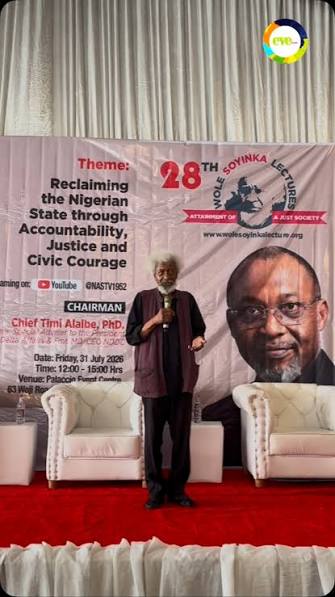
Alaibe, spoke as chairman at this year’s Wole Soyinka Lecture Series, under the theme
“reclaiming the Nigerian state through accountability, justice and civil courage.” The lecture series is the brainchild of the National Association of Seadogs, NAS, founded by Soyinka.
Alaibe said although Nigeria was blessed with extraordinary human talent, abundant natural resources and remarkable resilience, “we continue to fall short of our collective potential. Our national challenge has never been a lack of diagnosis; it has been a failure to act consistently on what we already know. Too often, the institutions designed to hold power accountable have been weakened. Justice, for many Nigerians, remains a privilege rather than an inalienable right.”
He said NAS has, over the years, fought against some of the issues holding the country down, especially tribalism. “From its very beginning, NAS has stood against colonialism, partisanship, clannishness, ethnic chauvinism and statism, while upholding the enduring values of nationalism, absolute honesty, absolute selflessness, and love for all.
“Today, we must be honest with ourselves: those values are being steadily eroded, and their essence is fast disappearing. Tribalism has become less an individual prejudice than a systemic condition, coursing through our national bloodstream and eating away at the very fabric of our society.
“It should trouble us deeply if members of the National Association of Seadogs have, at times, also fallen short of these enduring ideals. Reclaiming the Nigerian state must therefore begin with reclaiming ourselves – by ensuring that the principles we so proudly profess are applied consistently, without fear or favour, irrespective of tribe, political affiliation, or the identity of those who wield power.
“Ultimately, accountability is sustained not by laws alone but by the courage of men and women who insist those laws apply equally to the powerful and the powerless. Civil courage – the willingness of citizens and institutions to stand for what is right, even at personal cost – has not always risen to meet the defining moments of our national life.”
Alaibe said the country and its people needed to be decisive in the battle to reclaim its lost glory through the steady accumulation of principled choices – by citizens who refuse to be indifferent, institutions that remain faithful to their mandates, and leaders who choose integrity over expediency and courage over convenience.
He added: “My own years in public service, particularly in regional development and institutional reform in the Niger Delta, have reinforced one enduring lesson: sustainable development cannot exist where accountability is absent. Where institutions are weak, hope gives way to cynicism; where accountability is upheld, even limited resources can produce lasting impact.
“For nations are not reclaimed by rhetoric alone. They are reclaimed when conscience triumphs over convenience, when institutions are stronger than individuals, and when citizens summon the courage to do what is right, even when it is difficult.”
Alaibe acknowledged Soyinka’s contribution to peace in the Niger Delta, saying it was the Nobel Laurette that suggested the introduction of what he called intellectual militancy as a way of drawing the government’s attention to the development challenges in the region.
Hr recalled how Soyinka addressed a gathering in the region, where he spoke against militancy, as it was at that time. “In his address, our Guest of Honour offered wise counsel to the young men who had taken up arms, urging them to choose dialogue over violence and a future built on peace rather than conflict. With characteristic moral clarity, he challenged them to embrace what he memorably described as “intellectual militancy in pursuit of the region’s development.”
“It was a powerful call to exchange the force of weapons for the power of ideas, knowledge, and constructive engagement. I recall these moments not merely out of nostalgia, but because they speak directly to today’s theme.
“Long before ‘reclaiming the state’ became a familiar phrase, our guest of honour was already living it’s meaning — journeying to a remote community many considered too insignificant to matter, commissioning a library dedicated to learning and hope, and living among us without ceremony or pretense. In doing so, he affirmed that the true measure of leadership is not the distance one travels, but the willingness to stand with people wherever they are.”