The demand for resource control and environmental justice has remained the heart of the Ijaw struggle. In this exclusive interview with EDITH CHUKU, the newly inaugurated Vice President 1 of the Ijaw National Congress, INC, Dr. Felix Tuodolo, spoke on the history and future of the Ijaw struggle, insisting that resource control remains non-negotiable.
Tuodolo, the pioneer president of the Ijaw Youth Council, IYC, also spoke on the quest for self-determination, environmental degradation and governance in the Niger Delta, as well as the priorities of the new INC leadership in protecting Ijaw interests and advancing the region’s development
Excerpts:
You have been deeply involved in the lingering effort of the Ijaw people to achieve greater autonomy and control over their resources. Could you share your perspective on where the struggle stands today?
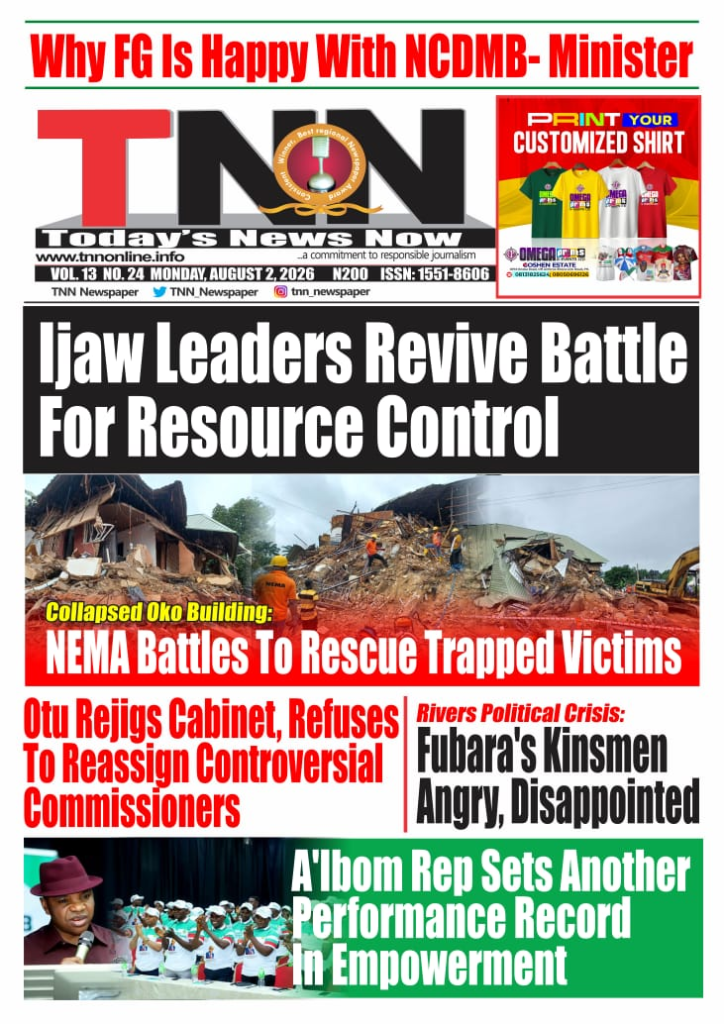
Well, every struggle has its ups and downs, successes, mistakes, failures, here and there. Our struggle is mainly for the liberation of our people; for our people to control the resources found in their land, given to them freely by God. It’s a major pillar of our struggle and I want to say that till today, we have not got there; we are still on the way. I must say that it didn’t start from us. Our forefathers started this struggle. It wasn’t crude oil, so to say, then. But it was still oil. There was oil in the Niger Delta; palm oil trade which the white man, Europeans and co, came in and had a struggle with our forefathers like King Jaja of Opobo, King Koko of Nembe, King Nana of Itsekiri, and Bekederemo of Kiagbodo, and so forth. But after that era, it continues, where people like Harold Dappa Papa Biriye took the struggle on politically. He led it to London in the Lancaster Conference and we have not been satisfied with it. People like Isaac Boro took up arms against the Federal Government of Nigeria because we were not getting anywhere and past government were not listening to the agitations of our people.
Like I said, it was palm kernel before; now it’s oil found in our land, all across the Niger Delta, it’s there in so many communities. We the Ijaws, we have a big chunk of it found in our land and we don’t get anything from it; what we suffer is environmental degradation, health issues, unemployment, marginalisation; both by oil companies and the government that be. And so it’s a struggle that we want an end to. We want to control our resources because the resources or the minerals in Nigeria is not just oil. Presently, you must have been hearing of the gold and coal up north, it’s not federalised, where it is brought to the federal purse and shared amongst all of us, it’s only our oil and why should it be so?
There are several mineral up there and in many other communities, we don’t begrudge them, what is happening to them we want it to happen to us; allow us to mine our God given natural resources, just like some other people have and are doing it, that is what we just want.
This struggle has persisted, from one generation to another without significant change. Do you believe meaningful progress is possible now, or is this struggle an ongoing inheritance that each generation must endure?
(Laughs). Well, I am hopeful because there is always an end to a struggle. We didn’t start with what we have today, there was one time it was a 3 per cent derivation, it moved lower to 1.5, it came up to 3 per cent and now it is 13 per cent, which is still appalling, very, very appalling. We believe that with what we are doing and as we continue this struggle, it will go up. If others are controlling the little things found on their land, we should be allowed to do the same. I believe, one day, one day, if government is sincere enough to explore resources found in all the land, then, every land, every people, every nation in Nigeria will be allowed to control their resources because you won’t be depending only on that of one person. For now, the rest of the nation is parasitic on the Niger Delta people and it’s not acceptable to us.
What is your description of an ideal Ijaw land of your dream?
Resource control. That is the pilar of our struggle, we want, not just the Ijaw people- the Ijaws, the Ibibios, the Benins, the Isokos, the Urobos, the Ogonis, the Ekpeyes, the Ikwerres, and not just Niger Delta people, a situation where the rest of other ethnic nationalities should be allowed to control their resources, manage their resources and contribute to the centre, we contribute to the centre so that every nation in Nigeria can now develop at their own pace. What we have now is a situation where the development of states are tied to the revenue that comes from Ijaw land and the rest of the Niger Delta, while the Ijaw land and the rest of the Niger Delta are being deprived, some other nationalities are excelling, that contribute very little to the national purse and don’t suffer the kind of environmental degradation that we have in the Niger Delta. For us, this mismanagement of our resources at the federal level, this capturing of our resources is a form of slavery and we want freedom, we want to be free.
Away from the struggle, how would you evaluate the performance of the governors of the Niger Delta states, in terms of addressing the region’s challenges and fostering development?
Well, that is an area I rarely delve into; the performance of governors because they are not held accountable to the people. We the people have never held them accountable because whatever every governor is holding, whatever resources, whatever revenues that come to the states is on behalf of the people, but governors have had free hands in managing these resources without proper recourse to the people. Without even we the people holding them accountable for whatever they do and since we can’t hold them, we have not been able to hold them accountable, what does one say? But it is very few of them might be doing one or two things, I can’t give any of them an A in performance. Look at the case of Rivers State, we don’t know what is happening in Rivers State in terms of governance. Look at Bayelsa State, we see some new roads, new bridges here and there. What we can really give credit to that government is payment of pensions, payment of civil servants, that have been constant. Even, go to Delta State, in fact, all of them, could do better than what they are doing now, they could do better. We expect more. They might be trying their best but for we the people, we want them to do more.
Let’s focus on governance in Bayelsa. Would you say the government of the day has implemented effective measures to address erosion in the state?
Let me tell you one good thing the Bayelsa government has done which I give them credit for, the fact that government has undertaken a study of the environmental problems of Bayelsa State. They brought in international experts to come and do this and the former governor and present governor, Douye Diri, have been going from conference to conference, country to country, making a case of the environmental problems in Bayelsa State. And what are we talking about? We want what is happening in Ogoniland to happen in Bayelsa State, and not just in Bayelsa State, the rest of Ijaw land, and other communities and people that suffer same kind of environmental problems.


Erosion like you have pointed out is a very big problem in Bayelsa State. It happens mostly, in all communities that have fresh water, they suffer from erosion; the land is taken away, slowly, every year you see communities receding, going backwards, you have land today, you have house today, come next year, that house is closer to the river, come the other year that house has fallen. It happens in Aki, it happens in Ayama, it happens in Agoro, it happens in most communities in Southern Ijaw and so forth of Bayelsa State. So, erosion is a problem and we also have a natural situation of a flooding season and a none flooding season. Every flooding season, some level of erosion takes place,b eating away our land, eating away even fertile grounds, such that even affects the agriculture of the people and this is now compounded by the discovery of oil, that now even pollutes the land, the carelessness of oil companies; spillages from pipelines, from their facilities here and there further makes our problem of erosion worse because where we could have had succour, even the water is now polluted, our fishes die, our plants die, so much is destroyed. So, we need special attention. Bayelsa State and other parts of Ijaw land needs very, very special attention.
It happened long ago when the Willink’s Commission was set up to give special attention to the Niger Delta and from there, the Niger Delta Basin Development Authority, NDBDA, was set up to take care of the specific problem. That was the only basin development authority that was set up, not by Nigerians, but by the colonial masters because they saw the peculiar problems of the Niger Delta which includes Bayelsa today. Bayelsa, Delta, Rivers states, they saw it and set up the commission and development board. But when Nigerians took over government, they created more, created special development boards across Nigeria, making nonsense of the one that has been established specifically to take care of this peculiar problems of the Niger Delta people. They’ve bastardized it and the funding that purse like that gets these days, particularly that of the Niger Delta is appalling, very, very appalling, it’s sad.
You are the newly inaugurated Vice President 1 of the apex socio-cultural body; Ijaw National Congress, INC, an organisation that serves as a unified voice and umbrella body for the protection of Ijaw interests, culture, and development. What should Ijaw people expect from your regime?
You see, the INC is a socio-cultural body, the umbrella of all Ijaw people and it was formed to protect the Ijaw people, enhance development in Ijaw land and it is exactly what the INC will do. The present executive that has been inaugurated, though waiting for one or two issues because some complaints here and there, made the governor of Bayelsa State to intervene, to bring about peace and true reconciliation among the Ijaw people which we thank him for. But this executive council is here to do the right things; protect the Ijaw land, the Ijaw people wherever they are found, wherever we are oppressed, wherever there is need for development that we need to cooperate, this executive council is going to do much for the Ijaw nation.
We have a leadership from the president to the last person in the executive, even to the zones, very, very capable hands this time, that are determined to write their names on the history book of Ijaw land. We are ready to do that and that is what Ijaw people should expect. They should expect that wherever an Ijaw man is in problem, the INC will be there to protect him. Wherever the Ijaw land is threatened, the INC is ready to intervene.
For example, we are talking about some issues in Rivers State. You saw that the INC fought for Governor Sim Fubara when he was being oppressed, INC was totally behind him. This we will do for any other Ijaw man, any other Ijaw politician that will be oppressed. We cannot disappoint our people. We will also look into several issues affecting us, particularly some of the things we have discussed here; this issue of erosion and environmental despoliation, the INC will look at it, we are going to fight for the Ijaw nation in this regard and finally, the issues of resource control, is a pillar of our struggle and the INC will take it on its shoulders.
Already, some of our organizations that we belong to, affiliate organisations of the INC, we are in court, challenging the federal government on issues of resource control, and on more local governments for Bayelsa State. We are also in court on the Nigeria-Morocco gas pipeline, that will take our resources, our gas from our land without recourse to us, without any form of environmental redress, without any form of compensation, without even an EIA. You cannot transfer our gas to benefit ECOWAS, to benefit Morocco, benefit other people at our expense. That is what is happening to our oil and these are some of the issues the INC will not leave lying low; they are issues that are of fundamental interest to Ijaw man, that are of fundamental interest to our survival as a people and we must defend it. We will work for it.
Furthermore, we have been reading lately, some people making statements in Edo State that Ijaws are not there and that they should leave, that the land they occupy is a borrowed land or whatever. Those are some of the issues we are also even going to look into and handle because the Ijaws are aborigines in the Niger Delta.
The Ijaws settled in Edo State in that area and transported some of the people; the Benins and others across and I wonder how today you want to tell me that we are strangers in our own land. It is others that are strangers, it’s our neighbours that are strangers because they met us there, so, it’s another issue that we as the apex body of Ijaw nation will protect the interest of Ijaw man, not just in Edo State but anywhere it happens. We will also continue with some of the issues like ward delineation that is taking place in Delta State, it affects our people, a court has given a judgment, the Supreme Court has given a judgement in favour of Ijaw people and we will defend it. Some persons don’t want that judgment to be implemented, it’s so unfortunate. The Supreme Court is the highest decision maker in the land and if the Supreme Court has said do it in our favour, that our case is correct, some people are trying to stop it. INC, we are watching. We will not take it. Anywhere the interest of the Ijaw land is threatened, we will act.