OFONIME UMANAH
She was all smiles all day-from the thanksgiving service to the luncheon-as her children and family members celebrate her life and times, at 80.
While at the Lesuka Events Centre, Port Harcourt, where the luncheon held on Sunday, Madam Edna Abhili was surrounded by friends and associates-some of them immediate family members, Kalabari elders, former colleagues in the teaching profession, et cetera.

From time to time, as the master of ceremony, Angel De Laff, made efforts to set the hall on fire with ribs cracking jokes, the former French teacher at the Baptist High School Port Harcourt, would smile. If the joke was very interesting, then she would giggle. In fact, when the MC tried to speak what he wanted the audience to believe was French, she chuckled.
As she glanced through the beautifully decorated hall, listening to the sonorous presentation by a group of singers that relived memories of old school gospel hymns, seeing the quality of guests present, watching the grandeur and stylish layout and ambience around the environment, she must have been very happy with her children for deciding to honour her while still alive.
Ironically, Madam Edna did not look 80. Not at all. Her dress sense had a touch of class. Her intermittent smiles showed a happy woman who was enjoying her old age. Her make-up was simple, yet it made a statement in purpose, panache and purity.
Here and there were her grandchildren. Some of them were all over her. And she would pamper them with grace, but with attention fixed on what was going on in the hall-guests trooping into the hall as if it was a political gathering hosted by either Nyesom Wike or Sim Fubara.
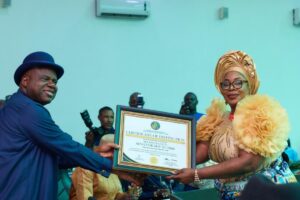
By the time she was called up to cut her cake, she walked graciously and elegantly, a step at a time to the podium, the steps a possible reminder of how she used to walk up to the blackboard to teach her students, some of who were there to celebrate her.
But shortly after cutting her 80th birthday cake, the unexpected happened. She shed tears. It was clearly an outpouring of tears of joy. She managed to control the tear drops and also control her emotions. It was impossible.
So, she let them out, freely, for a while. Her mind must have taken her on a trip. She must have remembered the sacrifices she made to raise the children and how they decided to honour her. She must have missed her husband who left her some 14 years ago. She must have thought of what would have happened if her husband were still alive to witness the epic event. She must have thought of how her final days on earth would be-how friends, family and associates would gather to celebrate her in death, as they celebrated her while alive. So much must have gone through her mind. But she was to get back herself as one of her sons, Abiye, continued to tap her shoulders, apparently reminding her that he and his siblings were very much with her. When that session was over, she was led to the dance floor by one of her family members who made her to display what looked like a redefined version of her age-long dance skills.
Those who made goodwill speeches attested to her character and finesse, her mien and her thoroughness as a teacher and as a mother.
One of those she taught, Mr Emmanuel Obe, a journalist who was also at the event, had this to say to TNN about her: “She was slim, beautiful, gentle and caring. We particularly admired her for her patience with us in getting along with the subject of French.
“She also stood out as one the few teachers then that had a car. I think she used to come to school in her Ford Cortina or so. So, she stood out. I regret that I did not offer French in the school certificate.
Her teaching was more interactive, that is, getting us to participate in the reading of the texts and answering questions. She didn’t use the cane or punish those who failed. I remember her coming to school with her first child, who was very young then, showing her commitment to children’s care and upbringing.”
Those who attended the birthday bash must have gone home with one lesson: it is better and more honourable to honour people when they are alive, than to do when they are dead.