Edith CHUKU

Determined to ensure that the safety, dignity and privacy of children are prioritized in news reporting, the United Nations Children’s Fund UNICEF, has challenged journalists to report child abuse without deepening victim’s trauma.
UNICEF warned that sensational or insensitive coverage could expose vulnerable children to further harm, stressing the need for media practitioners in Nigeria to imbibe child-sensitive and rights-based reporting.
The global United Nations agency founded on December 11, 1946, called for stronger media protection for vulnerable children, insisting that children’s vulnerability must never become media entertainment.
The agency urged media professionals to protect children’s voices, preserve their dignity and not turn their pain into headlines in news reports.
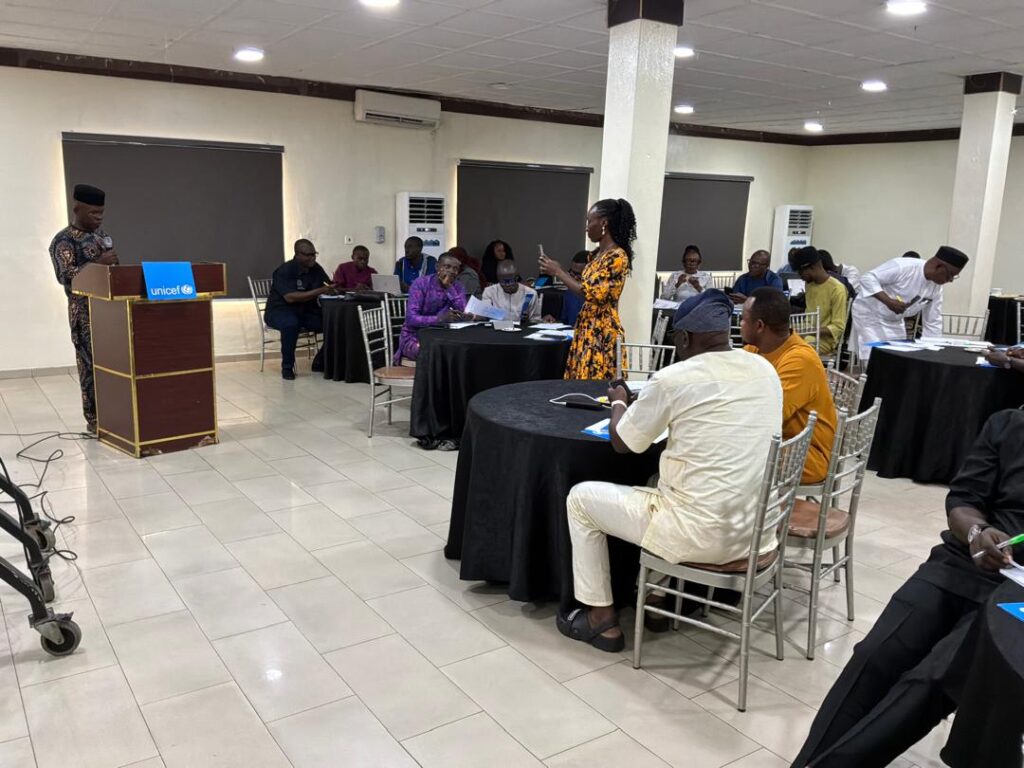
UNICEF gave this charge in a two-day Zonal Media Training organised in collaboration with the Broadcasting Corporation of Abia State, for journalists on Ethical Child Rights Reporting.
Editors, state correspondents, journalist from the print and electronic media from Abia, Imo, Anambra, Enugu, Rivers, Cross River, Benue and Delta, attended the workshop held in Port Harcourt, seeking safer ways of reporting without exposing vulnerable children to further harm and trauma.
Addressing journalists in her keynote speech, the Chief, Unicef Field Office, Enugu, Mrs Juliet Chiluwe, said the media has an extraordinary ability to bring children’s issues into the national conversation.
According to her, in Nigeria, children are affected by challenges including poverty, displacement, insecurity, malnutrition, barriers to education, violence, exploitation and other forms of vulnerability, which are stories must be told.
Chiluwe described journalists as not merely observers of society but shapers of society.
Her words: “Every day, through the stories you select, the questions you ask, the images you publish, the headlines you write and the voices you amplify, you influence how the public understands the world and when that world involves children, your responsibility becomes even greater.
“When you present a child in a newspaper, on television, on radio, online or across social media is not simply a subject of a story. That child is a person with dignity, rights, aspirations and a future. This is why our conversation over these two days is not simply about journalism. It is about professional responsibility, child rights and the kind of society we want to build.
“Colleagues, your stories can inform, expose child injustice, mobilize communities, influence, policy, bring resources and attention to a neglected child rights issues but a story can also cause harm, a careless headline can stigmatize a child, an inappropriate photograph can expose a child to ridicule or discrimination, an unnecessary disclosure of identity can follow a child for years, an interview conducted without sensitivity can reopen trauma and a story intended to generate public interest can unintentionally compromise a child’s safety, privacy or dignity.
“This is why ethical reporting must never be treated as an optional extra to good journalism. It is part of good journalism. The question should not only be: “Is this story newsworthy?”. We must also ask: “Is it in the child’s best interest to tell this story in this way?”. “Could this reporting put the child at risk?”. “Does this story protect the child’s dignity?”. “Am I giving the child a voice without exposing the child to harm?”.These questions should become part of our newsroom culture and part of our professional instinct.”
Chiluwe further advocated for a media environment in which every journalist understands that protecting children is not an obstacle to telling powerful stories, it is what makes those stories truly powerful.
On his part, the Director General, Apostle Francis Nwubani, who was represented by the BCA Director News and Current Affairs, Mr. Blessing Egbu, said children are among the most vulnerable members of our society.
According to him, they depend on adults and institutions to protect their dignity, privacy, safety and fundamental rights. Yet, in the course of gathering and reporting news, children can sometimes become exposed to unintended harm through sensationalism, inappropriate identification, intrusive interviews, stigmatizing language or the publication of information that compromises their safety and dignity.
Nwubani noted that “as journalists and media professionals, we occupy a position of considerable influence. Through our reports, broadcasts, headlines, documentaries and digital platforms, we shape public understanding and influence how society perceives children and the challenges they face.
“With this influence comes a profound responsibility. Ethical reporting of children is therefore not merely a professional requirement; it is a moral obligation.
“The way we report a child who is a victim of violence, abuse, exploitation, conflict, displacement, poverty or other forms of vulnerability can either contribute to the child’s protection and recovery or inadvertently deepen the child’s trauma and expose them to further harm. This is why workshops such as this are essential.”
He described the partnership with UNICEF as enduring, noting that it reflects a shared commitment to using the media as a powerful instrument for advancing the rights, protection and wellbeing of children.
“The media has an important role in bringing attention to violations of children’s rights, holding institutions accountable, amplifying the voices of children and communities, and promoting policies and interventions that improve children’s lives. When done responsibly, journalism can be a powerful force for child protection and social transformation.
“As BCA, we remain proud of our longstanding relationship with UNICEF and our shared commitment to communication that informs, educates and contributes meaningfully to the development and protection of our communities.
“We believe that strengthening the capacity of media professionals is one of the most sustainable ways of ensuring that issues affecting children receive the responsible and informed attention they deserve.I therefore urge all participants to approach this workshop with open minds and active participation.
“Let us share our experiences, ask difficult questions, challenge existing practices and, most importantly, commit ourselves to improving the quality of our reporting.The expectation is that when we leave this workshop, we will not only have acquired new knowledge but will also become stronger advocates for ethical, child-sensitive and rights-based journalism in our respective newsrooms and media organisations. You will also be issued a certificate by UNICEF at the end of this workshop.”