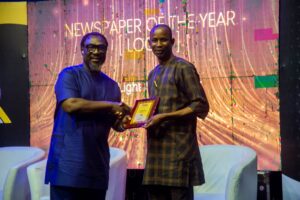
The minister of state for industry, Senator John Owan Enoh, has spoken of the federal government’s resolve to tackle the energy challenge in the country, having successfully dealt with the local content question.
Owan Enoh said at the 14th Practical Nigerian Content (PNC) Forum hosted by the Nigeria Content Development and Monitoring Board, NCDMB in Yenagoa, that it had become very urgent for the nation’s energy battle to be fought and won because local content could not thrive in darkness.
He said: Today, I speak to you not just as the Minister of State for Industry, with the specific mandate for industry at the Federal Ministry of Industry, Trade and Investment, but as an ambassador for a bold national agenda; one that positions industrialisation at the centre of Nigeria’s economic future.”
“For too long, Nigeria treated local content as an oil and gas requirement. Today, we recognise something profoundly more powerful: No nation scales local content without a strong industrial base. And no nation industrialises without a deliberate local content strategy. Local content is not simply a compliance framework; it is the foundation of industrial competitiveness.
“It is about retaining value within our economy, building indigenous technical capacity, creating jobs for Nigerian youth, manufacturing equipment locally, developing our raw materials and supply chains, strengthening SMEs and MSMEs, securing national productivity and sovereignty.”
“This is why President Bola Ahmed Tinubu placed industrialisation and local value addition at the heart of Agenda 7 & 8 of the Renewed Hope Agenda. And it is why the Federal Ministry of Industry, Trade & Investment is delivering the national Industrial Policy (NIP) 2025– 2035: A comprehensive plan to transform Nigeria from a consuming economy into a producing nation.”
Owan Eno said it would amount to nothing if stakeholders at the forum spent time to discuss about local content without a commensurate time to talk about the energy issues confronting the country. “No conversation about local content is complete without acknowledging the central issue.”
He added: Energy is the backbone of industrialisation. Manufacturers in Nigeria currently spend 40–60% of their production costs on energy. This is not just a challenge, it is a structural weakness that undermines competitiveness.”
He said his ministry convened the Ministerial Energy Roundtable on Industrial Energy Security, bringing together gas, oil, power, NNPCL, BOI, NSIA, InfraCorp, AfDB, Afreximbank and the private sector to deliver dedicated industrial power corridors, gas availability for industries, Naira-based tariff pilots, embedded generation for industrial clusters and a unified national framework for industrial energy reliability.

“Government cannot industrialise Nigeria without the private sector. The private sector cannot scale without government’s enabling environment. And Nigeria cannot win globally unless we work as one, he noted. Local content is no longer just a statutory requirement; It is our economic lifeline.
“Energy is no longer just a sectoral issue; It is the foundation of national competitiveness. The Nigeria First Policy is no longer a slogan; it is a strategic national imperative. Local content is not just an oil and gas philosophy; it is the backbone of national productivity. Industrialisa8on is the next frontier of Nigerian content, and this administration is determined to make Nigeria a producing nation again.”