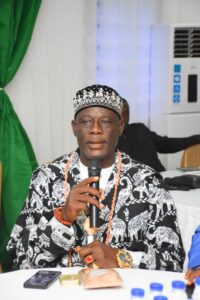
- Being Excerpts from the book, Thoughts and writings of Samuel Ogbuku, presented to the public on August 19, to mark his 50th birthday
I arrived the twin-tower Headquarter Complex of the Niger Delta
Development Commission (NDDC) to assume duties as its
Managing Director and Chief Executive Officer on January 5, 2023.
It was a momentous occasion for me but deep within me, I was
apprehensive. After years of agitating for the Federal Government to fix
the multifarious problems of the Niger Delta, and right the wrongs of
many decades, I had been saddled with the responsibility of effecting
the very change I campaigned for.
For the first time, an activist, who cut his teeth in the trenches,
fighting for the betterment of the region had been appointed to lead the
intervention agency. As I navigated my way inside the building, waving
and acknowledging the good wishes of the staff and stakeholders who
had gathered to receive me, my mind was stirred. It was a moment to
be proud of. But it was also a moment to be sober, for as I looked
around the beautiful edifice, I could also sense the cracks – not in its
physical walls, but in the Commission’s soul.
As the first substantive managing director in four years, this was
more than just another government appointment. It was a return to the
heart of a wounded Niger Delta region. My role will go beyond merely
leading and adding to the huge number of people that have been
appointed at different times to serve as its chief executive officers. I
must deliver to the expectations of the region. I saw it therefore, not as
RETHINKING THE NIGER DELTA
2
a political assignment, but as a sacred call to rebuild trust where it had
been broken and restart the punctuated transformation journey of the
Niger Delta with great speed.

From my very initial briefings with senior staff and other
stakeholders, I realised the magnitude of what the new Governing
Board led by Ms. Lauretta Onochie were up against. Morale was low.
Many had grown cynical, not just within the building, but far beyond it
— across villages, creeks, and cities in the nine states we were meant to
serve. NDDC projects had come to mean something abandoned, half-
done, or poorly done. Our people, rightfully, had grown weary of
promises.
Also, there was institutional fatigue. The NDDC had become a
revolving door of leadership. In twenty-three years, the Commission
had seen seventeen managing directors in different mutations. Most
lasted just over a year. A few stayed only months. The result was a crisis
of continuity. No leader had the time or space to implement a vision.
Every new board began afresh. Every new managing director had to
start from scratch.
I had been appointed by President Muhammadu Buhari just five
months to the end of his administration. The election of his successor
was a few weeks away. Would I serve into the new administration or
should I simply concern myself with the five months of the Buhari
government? It didn’t matter how long I would stay in the saddle; I was
determined to make every moment count for the Niger Delta.
The forensic audit which preceded my appointment presented a
damning report: Over 13,000 abandoned projects; poor financial
management; a system riddled with duplications, inflated contracts,
and nonexistent oversight. Early in our tenure, the Governing Board
requested, received and studied the full forensic audit report. The
findings were sobering. Our attitude was to see the audit, not as a burial
certificate, but as a critical roadmap; a guide to what needed to change;
a handout for corrective action. For the Board, it was raw material to
frame our governance reforms and clean-up strategies.
So for me, it didn’t matter how long I will serve at the top; this would
not be business as usual. We would commit to doing things differently.
We would rebuild the Commission — not just restructure it on paper,
but reform its culture, restore its integrity, and reestablish its credibility
with the people of the Niger Delta.
THOUGHTS AND WORDS OF SAMUEL OGBUKU
3
Thankfully, President Bola Ahmed Tinubu‘s Administration has
been a massive blessing. His decision to reappoint me as Managing
Director – along with some members of the Board he inherited – was a
bold statement to restoring leadership stability. Indeed, his Renewed
Hope Agenda has so many sweet spots for the Niger Delta.
Still, I understood that more time alone would not save us. We
needed structure, discipline, and a reorientation of our institutional
mindset. That meant we would tear down old scaffolding and lay new
foundations; foundations strong enough to carry the weight of the
region’s hopes and aspirations.
That realisation became the seed of the Rewind to Rebirth agenda of
the Governing Board. The rewind part is essential because to move
forward, we needed to look backward. What did the Commission do
right? What went wrong and why? Why were so many people — from
villagers in Bayelsa to Distinguished Senators in Abuja — convinced
that the NDDC was beyond redemption even with the impactful
projects that it had undertaken across the region? To rewind meant to
go back to the core values on which the Commission was founded:
equity, accountability, regional development. With rebirth we are
saying that it is not enough to just critique the past. We must become
something new. Something better.
Rebirth speaks to our future. A reborn NDDC would not just
repackage old ideas. We must transform the way we do things: How we
select projects, engage communities, manage funds, and evaluate and
communicate our successes. Rebirth means transitioning from a
Commission known for the number of contracts it awards, to one that
constantly impacts lives and drives socio-economic growth and progress.
This meant we had to change how we thought about development. So
we made a philosophical shift from transaction to transformation,
which I call the Triple T. To accomplish this, we engaged KPMG, a
leading global professional services firm to help us rebuild the internal
culture and corporate governance mechanism at the Commission. We
charged them to design and implement Standard Operating Procedures
(SOPs) for every unit and department so that every action within the
Commission is guided by clear, documented processes, workflows,
clearly defined roles, and protocols that reduce discretion and increase
accountability.
RETHINKING THE NIGER DELTA
4
We have introduced Key Performance Indicators (KPIs), not just for
projects but for people. Every directorate had to show impact. Every
manager had to account for time, funds, and outcomes. We were not
simply changing what we did; we were changing how we worked, and
more importantly, why we worked.
At inception in 2000, the pioneer board and management adopted a
bottom-up approach to project design and execution. That meant
involving community stakeholders in the project selection in order to
align to their needs. We have kept that faith. Our administration is big
on stakeholder engagement. We have held various stakeholder forums,
town hall meetings, stakeholder summits, and community engagement
sessions in all nine mandate states. I believe that to be a good leader, one
needs to listen. These engagements have helped us to understand the
real needs of the people. We heard from women farmers in Ondo who
had no access to markets. From youth leaders in Rivers who wanted
more than empowerment — they wanted inclusion. From traditional
rulers in Akwa Ibom who offered land for projects, but felt ignored in
decision-making. These voices became the backbone of our planning. I
recall a young man who approached me at the venue of one of those
forums and told me, “We have seen many MDs. We’ve heard many plans.
We don’t want stories. We want service.”
Ever since, I have determined to make sure everyday in the saddle
translates into a positive outcome for someone or community,
somewhere in the Niger Delta.
Rebuilding a broken house
You cannot renew a region if the institution meant to champion that
renewal is broken. The NDDC I met in January 2023 was broken and we
needed to fix it. It was suffering from acute crisis of confidence. Even
the good work the Commission had done over the years had gone largely
unacknowledged, drowned by the louder story of waste and failure.
While it has done so much across the region – and I make bold to say
there are hardly any of the 13,000 communities across the nine Niger
Delta states we serve that has not enjoyed the tangible impact of the
Commission – the public sentiment was clearly that the Commission
had not lived up to its promise. We needed to take actions that restored
confidence and trust, and tackle the negative narrative that was
dimming the Commission’s glow.
THOUGHTS AND WORDS OF SAMUEL OGBUKU
5
Luckily, the Renewed Hope Agenda of President Tinubu provided
the guideline we needed to overhaul the institution. It demands not just
good intentions, but verifiable outcomes. It inspired us to re-engineer
how we work, and institute innovation, efficiency, and integrity into
every facet of our operations.
One strategic action was the realignment of the entire structure of
the Commission. The Board immediately restored the 13 statutory
directorates defined in the NDDC Act in an administrative
housekeeping exercise aimed at ensuring functional coherence. We also
introduced monthly performance briefings where directorates report
not just activities, but outcomes. The Board demanded evidence of
execution, timelines, and budget adherence. These meetings became one
of our best tools for internal discipline.
To strengthen the emerging internal culture of accountability and
prudence, we entered into a Performance Bond with the Economic and
Financial Crimes Commission, EFCC. That partnership was historic. It
was the first time in the Commission’s history that an anti-corruption
agency was embedded into our performance structure. This bond
allowed the EFCC to independently monitor procurement processes,
contract implementation, and budget performance. It was a bold step.
It sent a clear message that today’s NDDC is committed to doing things
differently and is not afraid of scrutiny. In fact, we welcome scrutiny. I
believe transparency is not a threat to good work; it is proof of it.
However, there is a need to balance transparency with agility; to be
accountable without being paralysed by paperwork. We must be flexible
without being frivolous. The road to rebuilding public trust and
operational credibility requires a covenant with the people of the Niger
Delta
It is one reason we have been aggressive in engaging with our
stakeholders. As you may recall, President Olusegun Obasanjo had
reminded Nigeria at the inauguration of the pioneer Board that the
Commission was not the sole change agent in the region but a facilitator
positioned to partner – and not usurp – the roles and responsibilities of
other stakeholders in the development of the region. This is the basis
for our outreach to state governments, traditional councils,
international oil companies operating in the region, donor agencies, and
the private sector. While most of these stakeholders have their statutory
RETHINKING THE NIGER DELTA
6
obligations to the region, we believe their oversight, collaboration and
partnership will create the right development synergy the region needs.
Hope rising
Change is not always immediate. You see it in small shifts, cautious
optimism, a changed tone in staff meetings, gratitude from beneficial
communities, completed projects in a long-forgotten village. That’s how
we began to sense that hope was rising. After months of planning,
restructuring, and reorientation, we began to commission projects that
were stalled for years — some for more than a decade. In Delta State, we
reopened the Abraka–Oben Road — a vital link that had been
impassable for years. In Abia, the Eziama–Abba Road was completed,
providing access to rural markets and reducing travel time. In Bayelsa,
the 25.7km Ogbia–Nembe Road, constructed in partnership with Shell
Petroleum Development Company (SPDC) was commissioned.
In addition to roads, we focused on energy infrastructure —
installing more than 120,000 solar-powered street lights in our
innovative Light Up Niger Delta campaign. Our plan is to light up all
Niger Delta communities. We are working on solar mini-grids to power
rural electrification in underserved communities. Imagine what access
to constant power can do to small businesses, students, and households
in our communities.
We have resumed the NDDC Free Medical Outreach that fills the
yawning gap in access to quality healthcare in the region. Since
inception, NDDC has treated more than 3 million people through these
outreaches. We are working to complete the Regional Specialist
Cardiovascular and Orthopedic Hospital in Port Harcourt as a
reference hospital for the region.
In education, we have partnered with the Renewed Hope Initiative,
led by the First Lady, Senator Oluremi Tinubu to distribute over 45,000
uLesson tablets to primary and secondary school students in remote
areas. Each device comes preloaded with the national curriculum,
adapted to local content.
We have also launched the Project HOPE Initiative, a region-wide
programme to register and profile youth by skill, aspiration, and
location. HOPE is an acronym for Holistic Opportunities Projects of
Engagement. It is a data-driven approach to empowering our youths
THOUGHTS AND WORDS OF SAMUEL OGBUKU
7
and young people, and to guide our future empowerment schemes and
youth interventions.
All of this began to restore public faith in the Commission. People
and agencies who were shy of dealing or relating with NDDC now
openly associate with us. We are entering into many strategic
partnerships with select stakeholders to ramp our development
interventions, complete strategic projects and steady our sail on the
road to growth, regional prosperity and development.
Our partnership with the Nigeria LNG Limited will see to the
completion of the 6.2-kilometre Kaa-Ataba Road and bridges linking
the Khana Local Government Area to the Andoni Local Government
Area of Rivers State as well as the Okrika-Borokiri Bridge. On
completion, the 1.2-kilometre Kaa-Ataba bridge will be the longest
bridge in the region.
As part of the NLNG partnership, we have also flagged off the
construction of the 27.1-kilometre Bonny Ring Road and Bridges in
Bonny Local Government Area of Rivers State.
It is heart-warming that nowadays, the Commission is receiving
more requests and solicitations from communities for interventions
than ever before. They know and believe that NDDC is working and the
Commission is committed to addressing their challenges. If we were
not performing, we probably would have had series of protests and
blockades of our facilities as it used to happen in the past.
We will steady our gaze on the road ahead. We remain committed to
lifting our people and communities out of poverty and despair. And the
progress we have made so far gives us reason to believe that we are alive
to our mandate for change.