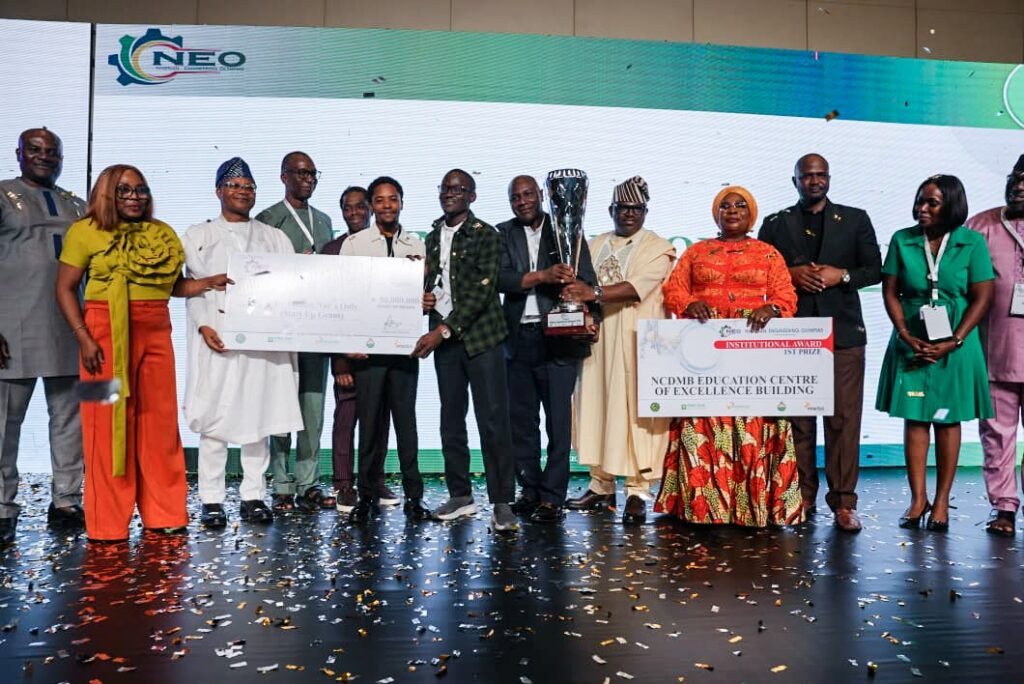
The maiden edition of the Nigerian Engineering Olympiad has ended in Lagos, with Team Mavericks of the Modibo Adama University, Yola, going home with the N50m prize money, courtesy of the Nigerian Content Development and Monitoring Board (NCDMB).
The Board has been at the forefront of Nigeria’s drive to develop indigenous engineering capacity, rewarding exceptional innovation and investing in a new generation of young Nigerians.
At the grand finale of the Olympiad the university emerged overall champions with their “Sarafa Community Security Alert” innovation, a community-powered rapid alert system that connects households through low-cost devices to instantly notify neighbors and emergency responders during security incidents.
Apart from the cash prize, the Faculty of Engineering of the institution will benefit from the construction of a Centre of Excellence Building sponsored by the NCDMB.
The competition, which had Enactus Nigeria as technical partners, was sponsored by the NCDMB, and the duo of Renaissance Africa Energy Company and First Exploration & Petroleum Development Company (First E&P) were funding partners.
The Olympiad showcased practical engineering innovations developed by students from tertiary institutions across Nigeria to address pressing national challenges through technology, entrepreneurship and locally-driven solutions.
Team Aurora of the University of Ibadan emerged first runners-up with their “Aurora Birth Health Tech Suite,” an innovation designed to reduce neonatal mortality arising from birth asphyxia in low-resource healthcare settings. The team received N30 million alongside engineering equipment worth N75 million. Coming third was Team Fortizo of the University of Jos with “FarmAnchor,” a solar-powered, Artificial Intelligence-enabled device that assists smallholder farmers in detecting crop pests, diseases and soil deficiencies.
The team received N20 million and engineering equipment worth N50 million, while Team Flameless of the University of Nigeria, Nsukka, secured fourth position with its “Flameless”containerised plug-and-play power solution that captures flare gas from marginal operators to generate between 100 and 500 watts of reliable and affordable electricity for nearby communities and received N10 million as reward.
Executive Secretary of NCDMB, Felix Omatsola Ogbe, who was represented by the Director, Planning, Research and Statistics, Mr. Omomehin Ajimijaye, reiterated the Board’s unwavering commitment to initiatives that develop human capital, promote entrepreneurship, stimulate innovation and create opportunities for young Nigerians to realise their full potential.
While congratulating all participants and appreciating the NCDMB’s partners for ensuring the success of the initiative, the NCDMB boss described the event as “far more than a grand finale,” but “a celebration of talent, innovation and the immense potential of Nigerian youths to solve real-world challenges through science and engineering.”

He explained that as the government agency charged with driving Nigerian Content development, the NCDMB remains committed to creating opportunities that empower youths, strengthen local capacity, promote entrepreneurship and inspire innovations capable of contributing meaningfully to national development. “Our mandate is clear,” he stated.
“It is to build human and institutional capacity that enables Nigerians to compete successfully not only within the oil and gas industry but across the wider economy. For us, youth development is not an afterthought; it is a strategic investment in Nigeria’s future.”
Ogbe disclosed that the NCDMB’s commitment is evident in several ongoing initiatives. According to him, another panel of judges is currently evaluating entries for the NCDMB Technology Innovation Challenge at the Board’s headquarters in Yenagoa, Bayelsa State.
He further revealed that NCDMB had just launched the Young Researchers Programme, designed to nurture research and innovation among Nigerian youths, with no fewer than 500 undergraduate students already enrolled.
“These are deliberate investments aimed at developing researchers, entrepreneurs and future industry leaders. Together with our stakeholders, we are building a strong pipeline of engineers who will develop indigenous solutions, deepen Nigerian Content, strengthen our industries and enhance Nigeria’s global competitiveness in science, engineering and technology,” he said.
Also speaking, the Country Director of Enactus Nigeria, Mr. Michael Ajayi, said the journey to the maiden Nigerian Engineering Olympiad began over two years ago.
“Today may appear to be the finish line, but it is actually the beginning of a much bigger journey that will ultimately ensure every engineering student in Nigeria develops ideas capable of transforming the nation,” he stated.
Ajayi disclosed that the competition attracted 375 applications from 984 students across 80 tertiary institutions, including universities, polytechnics and research institutions representing the six geopolitical zones.
According to him, the entries underwent a rigorous multi-stage assessment process involving 202 judges and evaluators, 177 professionals, over 852 man-hours of evaluation and six regional competitions.
Following the initial screening, the top 30 innovations emerged, with five selected from each geopolitical zone. Each of the top 30 teams received N3 million development grants, amounting to N90 million, to further develop their ideas to a prototype over an eight-week period.
The competition subsequently progressed to regional contests before producing the top 12 finalists. Recognising that engineering innovation also requires commercial viability, a two-week intensive business development and management boot camp was organised to equip finalists with bankable business plans.
Ajayi commended NCDMB, Renaissance Africa Energy and First E&P for supporting the initiative, stressing that transformational national development can only be achieved through effective collaboration among government, the private sector and development organisations.
Representing First Exploration & Petroleum Development Company Limited, the General Manager, Engineering and Capital Projects, Engr. John Alani, said the company was proud to support the initiative, noting that “Nigeria is not suffering from shortage of talents but rather from a shortage of structured opportunities.”
He added that the Olympiad provides exactly the kind of platform capable of transforming brilliant ideas into real-world solutions. Referring to a 2023 industry survey indicating that only five per cent of Nigeria’s engineering graduates are industry-ready upon graduation, Alani described the statistic as disturbing and said the Olympiad represents a practical response to bridging that gap.
He commended NCDMB for its visionary leadership in engineering capacity development, noting that the Board’s investment would help build the skilled workforce required to drive Nigeria’s industrial growth for generations.
Also speaking, the Vice President, Relationships and Sustainable Development of Renaissance Africa Energy Company, Mr. Igo Weli, described the initiative as consistent with the company’s commitment to supporting innovation.
According to him, Nigeria’s greatest challenge is not the absence of talent but the lack of enabling environments for innovation to thrive. He further pledged to engage fellow sponsors towards increasing the N3 million innovation development grant awarded to participating teams.
Representing the President of the Nigerian Society of Engineers (NSE), the immediate past President, Engr. Margaret Oguntala, FNSE, applauded NCDMB and its partners for transforming what began as an idea into a national movement for engineering innovation.
She described the Nigerian Engineering Olympiad as one of the country’s most significant platforms for engineering innovation and entrepreneurship, noting that its vision is to identify exceptional engineering talents, build their capacities, promote entrepreneurship and transform innovative ideas into scalable solutions for national development.
She commended the participating students for demonstrating that Nigeria is not short of ideas but possesses abundant innovative capacity capable of solving national challenges.
Meanwhile, among the top 12 finalists that advanced to the quarter-finals and semi-finals were Team Protonics of the University of Port Harcourt with “Keytric,” a Wi-Fi-enabled smart door lock that automatically controls household appliances to reduce energy waste and fire risks; Team Vhorde of the University of Benin with AI-powered Smart Glasses designed to improve mobility for visually impaired persons; Team Oil Alchemist of Imo State University with the Waste Oil Reactor (WOR)
WOR is a portable pyrolysis system that converts waste engine oil into LPG, petrol, kerosene and diesel; and Team Health Guardian of the University of Lagos with the Health Guardian AM Detector for early detection of preterm premature rupture of membranes in pregnant women.
Others were also Team Tri-Catalyst of the University of Abuja with a locally-produced hierarchical zeolite catalyst for improving gasoline quality; Team Goodnews of the Nigerian Army University, Biu, with “PipePetrol,” an AI-powered pipeline surveillance solution; Team Adustech of Aliko Dangote University of Science and Technology, Kano, with an AI-enabled solar agricultural dryer; and Team Agritherm Solutions of Ahmadu Bello University, Zaria, with a solar-powered cold storage system designed to reduce post-harvest losses among smallholder farmers.
The event was attended by senior officials of NCDMB and other stakeholders, including the General Manager, Nigerian Content Development, Mr. Olarenwaju Olawuyi, who declared the event open; General Manager, Social Performance and Investment, who declared the event opened, Mr. Emmanuel Anyim; General Manager, Capacity Building and Supplier Development, Mr. Kenechukwu Akubue; Head, Capacity Assurance, Mr. Olabanji Abisiga; Head, Nigerian Content, Engr. Morinsola Aweda; alongside representatives of government agencies, academia, industry and professional bodies.