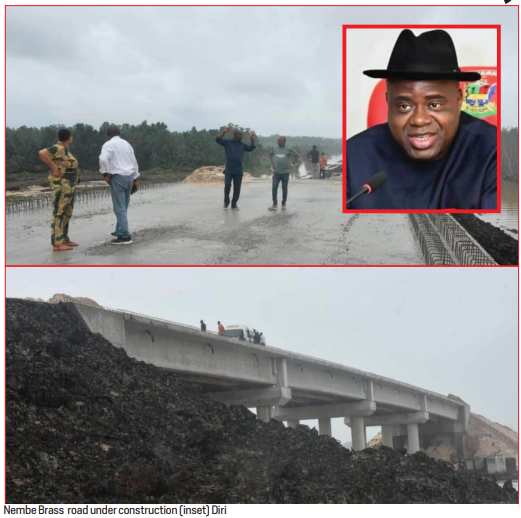
Comments by a former governor of Cross River State on the controversial Lagos-Calabar coastal road has attracted the attention of the governor of Bayelsa State, Senator Douye Diri.
Whereas Duke believes that the project was not doable because of the terrain, as well as the federal government’s suspicious handling, Diri sees his comment as one with political undertone.
To him, the project is doable, from his experience, having conquered such swampy terrains in constructing the senatorial roads in his state.

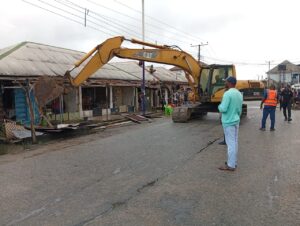
Duke had said in an interview on Arise Television that the project was an impossibility due to swampy terrain. The road constructed traverses nine coastal states, including Lagos, Ogun, Ondo, Edo, Delta, Bayelsa, Rivers, Akwa Ibom, and Cross River.
Duke had said: “The Lagos-Calabar Road is unbuildable. You cannot even go through Bayelsa. Bayelsa is swamp. Even Yenagoa, the capital, is swamp. You will probably have to build about 100 or 200 bridges to go through those swamps.”
Responding to Duke’s criticism in a statement issued by his Chief Press Secretary, Mr. Daniel Alabrah, on Wednesday, Diri expressed disappointment that a former governor of a south-south state in the heart of the Niger Delta region would criticise the project due to politics and not based on fact or reality.
He said Duke’s reference to Bayelsa and its difficult, swampy terrain was out of sync with the reality about development in the state, adding that if Duke was in tune with happenings in Bayelsa, where his administration had built roads and bridges across swamps and the mangroves, he would have known that the coastal road project was possible.
“I have seen the trending video clip of the former Governor of Cross River State, His Excellency Donald Duke, on an Arise Television programme.
“To say the least, I feel disappointed that former Governor Duke, who is from our region, made such comment. Clearly, he is not abreast of current developments in road construction and infrastructure development in our state.
“I want to believe that his criticism had political colorations and he did not consider the significance of a such a project to our region.
“In Bayelsa, we have successfully constructed dual carriage roads and bridges in similar terrain and our state is better for it. The Nembe-Brass road, the Sagbama-Ekeremor-Agge road, and the Yenagoa-Oporoma road, which are major causeways in our three senatorial districts, are all in swampy terrain. Ditto for the 630-metre bridge across River Nun at Angiama community in Southern Ijaw Local Government Area, which is one of the longest in the region.
“Dualised roads in the New Yenagoa City, the dualised Glory Drive Phase 1, 2 and 3 were built through the forest and swamps. Yenagoa is not what Duke described it.
“So, he is wrong. The Lagos-Calabar coastal road is buildable and possible.”
Diri further stated that the project was critical to unlocking development in the states and riverine communities along its pathway.
According to him, the coastal highway is also very dear to the Ijaw ethnic nationality as it is one of the projects that the Ijaw National Congress (INC), even from its inception in the 1990s, clamoured for.
He said it was only the administration of President Bola Tinubu that eventually undertook the project after many years of presenting the request to previous governments at the centre.