By John Odhe, YENAGOA

As part of proactive measures to mitigate the effects of flooding in communities in Bayelsa State, the Nigerian Red Cross Society (NRCS) has built the capacity of coastal areas in some selected flood prone communities in three local government areas of the state, namely Southern Ijaw, Sagbama and Kolokuma/Opokuma local government areas.
This is to prepare them on how to tackle the situation when it happens.
The secretary general of the Nigerian Red Cross Society, Dr. Abubakar Kende, said “in Nigeria we have over a million volunteers across the 774 local government areas of the country.
“Here in Kaiama Bayelsa State, we have been supporting the community in all the ranges of disaster management , early warning, preparedness, response and rehabilitation. The idea is that as long as we know that this community is having perennial flood every year and the idea is that anytime there is flood we can jointly work together with our stakeholders and salvage the situation and save people’s lives and provide them with dignity.”
The project tagged “Disaster Preparedness Project” is supported by the International Federation of the Red Cross through the European Union for Civil Protection and Humanitarian Aid (ECHO)
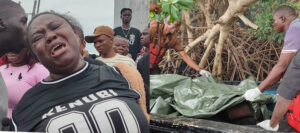
Speaking at the simulation exercise as part of activities to mark this year’s World Red Cross Day in Kaiama, headquarters of Kolokuma/ Opokuma local government area, the senior disaster manager for the International Federation of the Red Cross and project manager for the EU funded project, Idaraobong Ekanem, said the project involves training community members on how to monitor early warning signs and setting up community based disaster response management committee.
She said: “We’ve had a series of activities in this community and other communities in three local government areas in the State. We have trained and practiced with the community on how to monitor early warning signs of flood because this community, Kaiama, is a flood prone community and they experience flooding every year . Instead of having a reactive response, we want to have a proactive response.
“We have been here for some time now , training them, setting up community based disaster response management committee , also doing community mapping of flood prone areas
“We have gone into the community to also sensitize the volunteers and community members on early warning signs using indigenous knowledge and monitoring of river gauge.
“We have installed a river gauge in the river and trained someone to be monitoring the gauge. This is to help them to be better prepared so the flood does not meet them, they evacuate.
“The reason for the simulation exercises here today is to practice with the community how to read the river gauge, how to listen to the warning signs, how to evacuate on time, how to practice search and rescue, and how to move to safer ground that they have jointly mapped out in the community.”
The women leader of Kaiama town, Tonbara Akene, said: “We have never had it like this, in times past whenever there is flood, everybody will be on their own, but with this programme , I think we have a team that is ready to rescue people and at the same time the community disaster management committee is ready to go out there to tell them the warning signs immediately the flood starts coming because most people don’t know when the flood is coming, they just see flood.
“But this time around the warning signs keep going on, the blue flag, the red flag, the yellow flag and even the last one, the green flag which means everybody has to come back home that the flood has receeded .
“You give them early warning first so that they can begin to harvest their crops, pack their loads to a safe place and begin to relocate to a higher ground.
“I want to really appreciate the Red Cross and the European Union. They have built a water project for us so that when there is flood we have safe water to drink, they have renovated public toilets, they gave us canoes, life vests, stretchers, and ropes.. They make the work very easy for us. So if there is flood today, we don’t have any alarm to begin to run around to look for all these things , everything is ready for the flood .”