By Sola Adebawo
Africa’s private-capital market has delivered an impressive headline.
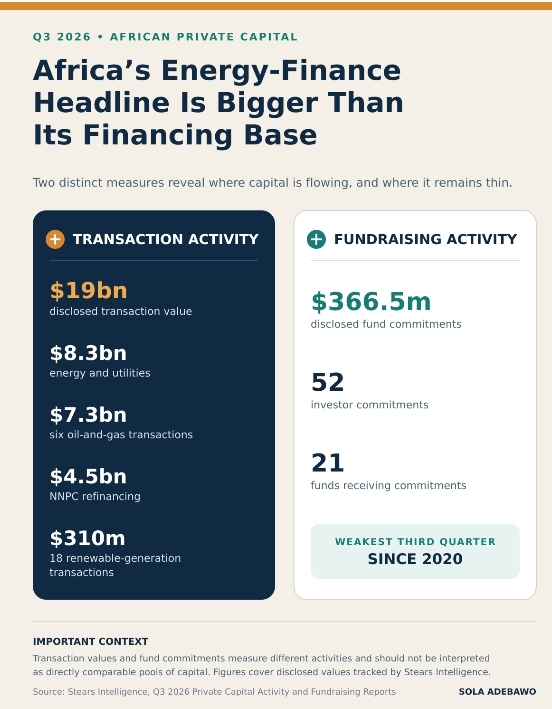
Stears Intelligence identified 240 African private-market transactions in the third quarter of 2026. Among transactions with disclosed values, the total reached $19 billion, the highest third-quarter figure in its 2020–2026 series and 57 percent above the preceding quarter.
Yet Stears’ separate fundraising report was less encouraging. Investors made 52 commitments, worth a disclosed $366.5 million, to funds investing in African businesses and projects. It was the weakest third quarter since 2020. Only 21 funds received commitments, down from 40 in the preceding quarter.
The reports measure different activities. The $19 billion covers transactions recorded during the quarter. The $366.5 million represents commitments to investment funds that may deploy capital over several years. Large transactions can also be financed directly by banks, development institutions and companies.
Fundraising does not capture every source of project equity. But the decline suggests that one important channel of risk capital is narrowing while large transactions continue to attract finance.
Africa’s energy projects are not simply short of money. They are short of capital willing to enter before outcomes become reasonably certain.
Who pays before conventional lenders arrive?
In a 2023 study, the International Energy Agency estimated that Africa’s annual energy investment would need to exceed $200 billion by 2030. It calculated that $28 billion in concessional finance would be needed to help mobilise $90 billion in private clean-energy investment.
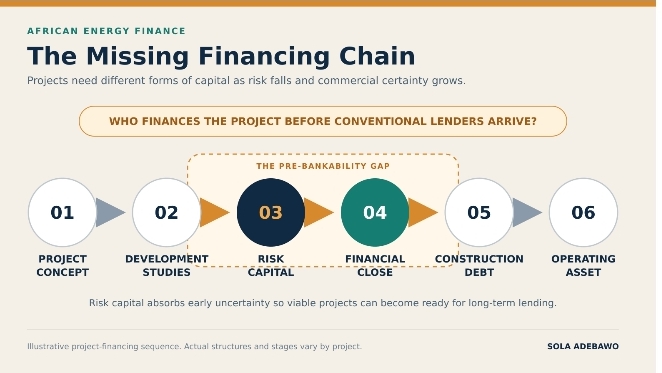
Before a power plant, gas-processing facility or transmission line can secure construction finance, someone must fund feasibility studies, engineering designs, permits, environmental assessments and commercial negotiations. That investor must accept that the project may be delayed, redesigned or abandoned.
Conventional lenders generally enter after major technical, regulatory and commercial risks have been reduced. Strong sponsors may fund early work, but many emerging African developers cannot.
Within Stears’ tracked transactions, debt appeared in 97 deals during the quarter, up from 67 in the preceding quarter and 58 a year earlier. Private credit accounted for 30 percent of recorded transaction activity.That is encouraging. African companies need longer-term loans. But lending does not necessarily help a project that is not ready to borrow.Such projects need risk capital, whose providers accept greater uncertainty for an ownership stake, higher prospective return or other compensation. Without it, a potentially viable project may never become bankable.
Why oil and gas receive the larger cheques
Within transactions tracked and classified by Stears, energy and utilities accounted for $8.3 billion in disclosed value. Six oil-and-gas transactions contributed $7.3 billion.
Renewable generation recorded 18 transactions, three times the oil-and-gas deal count, but only $310 million in disclosed value. That was below 20 transactions worth $619 million in the preceding quarter and 29 worth $537 million a year earlier.
The comparison shows where large commitments are flowing. It does not measure the projects’ generation capacity, social value or environmental performance.
Many oil-and-gas transactions involve producing assets, proven reserves, established infrastructure, large sponsors and hard-currency revenues. Renewable projects are often smaller and fragmented. They may sell to utilities struggling to pay, face politically sensitive tariffs, and borrow in dollars while earning local-currency revenues.
IRENA’s 2025 renewable-cost analysis illustrated the effect. It applied a 12 percent cost-of-capital assumption to African projects, against 3.8 percent in Europe. Although onshore-wind generation costs were broadly similar, financing represented a much larger share of the African cost.The technology may be competitive. The surrounding risks make its electricity more expensive.
Large transactions can conceal a shallow market
NNPC’s $4.5 billion refinancing represented almost one-quarter of the disclosed value in Stears’ tracked transactions.
It may strengthen NNPC’s balance sheet and create room for later investment. But it is not, by itself, new production or infrastructure.
The ten largest transactions supplied 62 percent of disclosed value, while deals exceeding $75 million accounted for 91 percent. Africa had a strong quarter for large transactions, not broad-based energy finance.
Nor should public money support every stalled project. Some lack early financing; others have unrealistic tariffs, unreliable customers, weak sponsors or poor economics.
Risk capital can help a sound project cross the distance between concept and construction. It cannot make an unreliable buyer creditworthy, turn an unsustainable tariff into a commercial one or replace enforceable contracts.
Every guarantee has an economic bearer. Risk-sharing must be transparent, limited and tested for affordability, value for money and potential public liability. Public capital should absorb risks markets cannot reasonably carry, not conceal projects that were never credible.
Building the missing financing chainAfrica therefore needs grants for technical preparation, early development equity, guarantees against defined risks, local-currency finance where revenues are domestic, and long-term debt once repayment becomes credible.
It also needs exit routes. Early investors must be able to sell mature assets to pension funds, infrastructure funds and long-term lenders, then recycle their capital into new projects.
For Nigeria, this matters across gas processing, embedded power, mini-grids and transmission. Announcing a project pipeline is insufficient if nobody will finance the work required before construction lending begins.
Progress should be measured not by one quarter’s transaction value, but by how many projects move from concept to feasibility, financial close, construction and dependable operation.
Africa is not entirely short of money. The deeper strategic question is who finances a project before it becomes safe enough for everyone else.
Sola Adebawo is an energy industry executive, strategic advisor and thought leader with nearly three decades of experience across Nigeria’s upstream petroleum sector. He is the Chief Executive Officer of Hyphen Partners Limited, a specialist advisory firm focused on policy and regulatory intelligence, market entry, stakeholder strategy, executive and institutional positioning in complex and highly regulated industries. A former executive at Chevron and Heritage Energy, he is an author, scholar and ordained minister. His writing explores energy policy, political economy, corporate governance, strategic communication, leadership, the relationship between institutions and public life, as well as the institutional forces shaping Africa’s development.