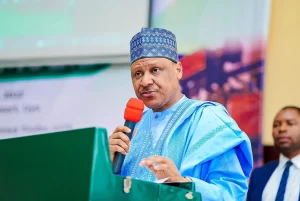
Akwa Ibom State governor, Pastor Umo Eno’s response to reports concerning the Jubilee Syringe Manufacturing Company and Kings Floor Mill, has sparked controversy over the industries established under the immediate past state government.
Eno gave this clarification while commissioning infrastructure in Awa, Onna Local Government Area of the state, the home town of his predecessor, Udom Emmanuel, on Monday.
He revealed that the industries established by his predecessor, operates as private enterprises rather than state-owned assets.
Udom, who governed the state from 2015 to 2023, made industrialisation a major component of his administration’s economic programme, with the state government announcing investments and partnerships involving several manufacturing and agro-processing ventures.
Some of the industries associated with the Udom’s administration were the Jubilee Syringe Manufacturing Company, Metering Solutions Manufacturing, Kings Flour Mill, St Gabriel Coconut Refinery, Lion Plywood and Timber Factory, Ibom Agricon Rice Processing Mill and Greenwell Fertiliser Blending Company.
During the Syringe Factory commissioning, the then vice president, Prof. Yemi Osinbajo, commended Udom for expanding the economic horizon of the state through industrialization.
At the state’s 32nd anniversary, Osibanjo who led top government officials to the state also inaugurated the 500 metric town capacity per day floor meal mill factory on September 21, 2019, where he commended Udom for attracting industries to the state.
He also charged other governors to emulate Udom in providing infrastructure to assist in industrial revolution in the country.
In his remarks, Udom said the flower mill was a fulfillment of his electioneering campaign promise to the people, as part of his efforts to make governance touch the lives of his people.
According to Udom, “the essence of this thing you are seeing here is just anchored on infrastructure development, we want to set the pace of good governance.”
At his inauguration in May 2023, Eno himself acknowledged Udom’s industrialisation drive, stating that the previous administration had attracted more than 20 industries to the state and had helped move Akwa Ibom beyond its traditional dependence on the civil service.
But seven years after, same Eno, who spoke in his local dialect, said the industries established by his predecessor were not owned by the government.
He said the state could not fix problems in the industries because they were privately owned.