BY John Odhe, YENAGOA
The magic wand of the Nigerian Content Development and Monitoring Board (NCDMB) in the oil and gas industry has continued to cut the attention of the African continent and beyond.
Ghana is the latest caller on the board to tap knowledge and experience on how to grow local content in their oil and gas sector.
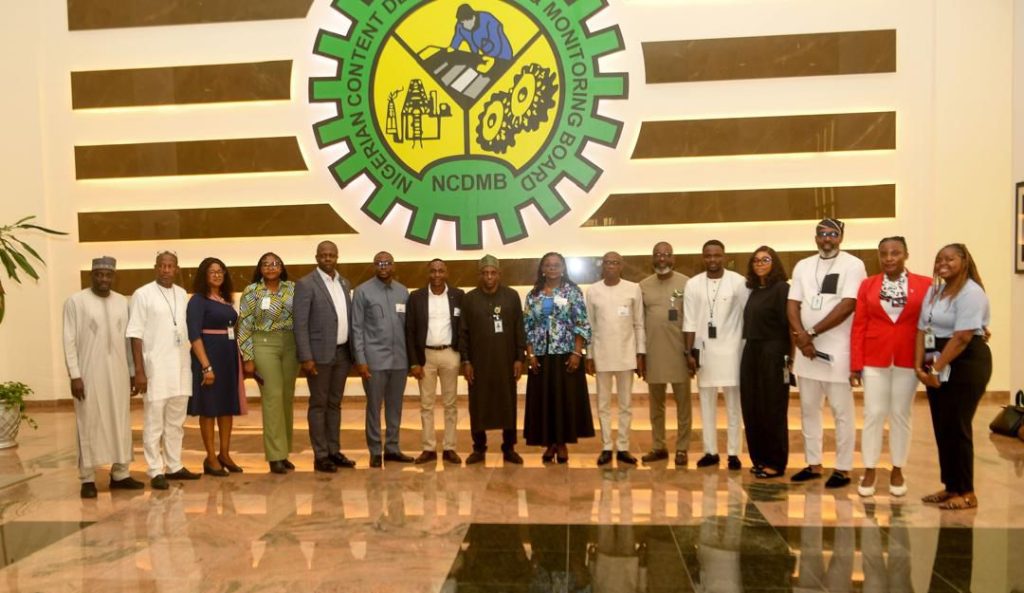
A delegation from the Ghana National Petroleum Corporation (GNPC) has visited the NCDMB on a knowledge sharing and local content bench-marking study.
This is with a view to deepening their understanding of the Board’s local content development practices in the areas of policy frameworks and implementation strategies, among other things.
According to a statement by the General Manager, Corporate Communications Division of the NCDMB, Dr. Obinna Ezeobi, the delegation, led by the Director of Corporate Affairs at GNPC, Mr. Eric Pwadura, was on week tour of the NCDMB’s corporate headquarters, Yenagoa, Bayelsa State.
The corporate communications GM said the delegation was received on Monday by the Executive Secretary, NCDMB, Engr. Felix Omatsola Ogbe.
The executive secretary remarked that Africa had evolved over the last three to four decades, growing its hydrocarbon resources to over 120 billion barrels of crude oil reserves and 800 trillion standard cubic feet of gas, which constitute over 10 per cent of hydrocarbon resources globally.
He said as a hydrocarbon resource continent, it was in the national interest of the producing countries to prioritise local content development, paying particular attention to the necessity of reversing the trend of dependency on foreign technology for exploration, field development and production activities.
He noted that the countries had to look inward for the capabilities to exploit their resources, he said.
Represented by the Director, Corporate Services of the NCDMB, Dr. Abdulmalik Halilu, the NCDMB boss explained the potential of “crude oil as commodity for economic transformation.”
Ogbe noted that Africa had the advantage of a huge youth population, comprising the labour force, which should be made to acquire the requisite skills for industry operations.
He recalled that Nigeria’s local content journey began with the Local Content Division in the defunct Nigerian National Petroleum Corporation (NNPC), managing local content issues in the oil and gas industry through mere policy directives, and transformed into the NCDMB of today.
“We have evolved from a policy to an institution,” he enthused, adding, “NCDMB is the sole agency responsible for local content” in Nigeria.
He disclosed that the board introduced the Nigerian content 10-Year strategic roadmap, which comprised five strategic pillars.
The pillars, he said, include: Technical Capability Development, Compliance and Enforcement, Enabling Business Environment, Organisational Capability, and Sectoral and Regional Markets.
He also mentioned five enablers to include: funding, regulatory environment, collaboration and stakeholder engagement, and research and development.
Among strategies for capacity building, Ogbe listed the Nigerian Content Intervention Fund (NCI Fund), which it operated through development finance institutions like the Bank of Industry (BOI) and Nigerian Export-Import Bank (NEXIM) to provide single digit loans to service companies.
“What we have done is to create that access to make the local service companies competitive,” he explained, adding that the facility has enabled indigenous companies to acquire critical assets and facilities, including marine vessels operating in Nigeria.
He pointed out that when capacities were built, they must be utilised, hence the board incentivised investments through a policy of First Consideration that favoured indigenous companies with demonstrable capabilities.
He advised African countries seeking to broaden indigenous participation in the oil and gas industry that “local content does not compromise standards. It does not mean you have African spec, European spec,” adding, “It’s one global spec.”
In focused presentation on the Nigerian Content 10-Year strategic roadmap, assistant manager in the Strategy and Transformational Projects, NCDMB, Dr. Zuwairat Asekome, gave highlights of the journey of the Board, beginning with the enactment of the Nigerian Oil and Gas Industry Content Development (NOGICD) Act, 2010.
He added that it went through successive stages of growth in the implementation of local content policy and monitoring to the present, when it had successfully raised in-country value addition in the industry to 61 per cent.
In his response, Pwadura expressed appreciation for the privilege to participate in a programme for knowledge sharing at the NCDMB.
He stated “Even though we have the legislation guiding local content, we have not had the benefit of having a robust local content environment like you have.”
According to him, “If we take our organization (Ghana National Petroleum Corporation), for example, what we have is a local content unit.
“That’s currently the structure that we have,” adding, “We want to have a deeper understanding of your local content development programme.”
In his remarks, the Director, Monitoring and Evaluation of the NCDMB, Barr. Esueme Dan Kikile noted the high interest of African oil producing countries in local content.
“It’s important that we work together; we are happy to continue to share our experience in oil and gas, share our experience in local content,” he stated.
In an opening address, Ezeobi, explained that “Nigeria and Ghana have had a long history of collaboration in the energy sector, and that the NCDMB and the GNPC have had fruitful interactions at international conferences.
He said NCDMB had mentored several African organisations on local content.
NCDMB, he added, had a Memorandum of Understanding (MOU) with the Petroleum Commission Ghana, the National Content Monitoring Committee of Senegal (ST-CNSCL), as well as partnerships with related agencies in Mozambique, Angolan, and Namibia.
Other delegates from the Ghana national petroleum corporation were Mrs. Jennifer Boateng, adviser, general services; Mr. Augustine Bayivella, principal, supply chain and local content development officer, and Mr. Seidu Salim Braimah, manager, supply chain and local content development.